Europe with kids: 10 best destinations for babies and toddlers
10
European destinations where parents of under 5s can actually relax—with verified childcare starting at age two or younger.
- Best overall
- Halkidiki for a baby-friendly beach plus childcare from 4 months.
- Shortest flights
- Mallorca, Algarve and Costa del Sol from the UK.
- For newborn care
- Salzburg or Sardinia.
Independent ranking · Affiliate links clearly disclosed
By Luana · Updated October 2026 · Every hotel personally researched · 70+ properties indexed across 14 countries
Why this guide is useful
How this list is different
Most "best Europe with kids" guides confuse "allows children" with "designed for children". You read 4,000 words about a city, get excited, then realise the recommended hotel's kids club starts at age 4 and your baby is 11 months old.
I built Tiny Trip Index because I needed the single piece of information that mattered most when we were planning our first holiday with a baby: what is the minimum age for the kids club? Most booking sites bury it. Travel blogs ignore it. So I started cataloguing it, one hotel at a time.
For this list, I filtered the 70+ hotels in the directory by one rule: at least one verified property in the destination must accept children from age 2 or younger in supervised childcare. Twelve destinations qualified. I picked the ten where the practical case for families with babies is strongest: short flights, walkable layouts, sensible food, and beach realities I can defend with a straight face.
You will not find Paris, London or Rome on this list. Those are great destinations once kids are walking confidently and sitting through restaurant meals; before that, these are the ones I'd research first.
Jump to a destination
The 10 destinations, ranked
Halkidiki
Greece

Sani Resort
Halkidiki solves a problem most parents have not thought about: where in Greece can I land, drive 45 minutes, and be on a 7km sand beach with a creche that takes my 5 month old. Thessaloniki airport is roughly 3hr 30min from London, and Sani Resort is 65-75km south on the Kassandra peninsula, a 45 to 60 minute transfer depending on traffic. The peninsula is greener than the Greek islands (pine forest meets sea, not bare rock), the beaches are properly sandy rather than pebbly, and the family hotel concentration is higher per square kilometre than anywhere else in southern Europe. Sani's Melissa Creche takes babies from 4 months and runs to published ratio standards under the Worldwide Kids programme. Ikos Olivia next door runs a Heroes Creche also from 4 months with published staff ratios, plus 30 minutes of complimentary beach childcare so parents can swim. The flat geography matters: paths between rooms, restaurants and beach are buggy flat at both resorts, no steps to negotiate with a sleeping baby in a pram. The tradeoff is resort-first: the holiday mostly happens inside the perimeter, not in cultural day trips. Thessaloniki city is 75km away and not really realistic with a baby on a beach holiday. It works when you want the entire holiday to happen inside a well run perimeter.
Stay here · Sani Resort
I'd put Sani first because the creche takes babies from 4 months under Worldwide Kids' published staff ratios and the beach genuinely shelves out 30 metres before adult waist depth. The complex is five hotels sharing one 1,000-acre pine forest estate with flat buggy paths throughout, so you book the hotel that fits your budget and use the whole resort. Free shuttle bus runs every 10 minutes between all five hotels and the marina. Transfer is 45 to 60 minutes from Thessaloniki, short enough to manage with a baby.
Read the full hotel reviewDon't miss · the beach reality
Sani Beach is 7km of soft sand that shelves out very gradually, often 30 metres before the water reaches an adult's waist. This is unusual for Greece and it is the single biggest practical reason families return. The sand is fine enough for a crawling baby and there are no sharp shells along the main stretches. Loungers come with shade umbrellas and the front rows are reserved early (set an alarm for 7.30am if you want one in July). Ikos Olivia's beach is the same coast, same sand, slightly less wide. Walking distance from rooms to beach is 3 to 8 minutes at both resorts depending on which block you are in. Pine trees behind the dunes give natural shade behind the lounger line, which matters at midday with a baby.
When to go
June and September are the sweet spots: air 25 to 29C, sea 22 to 25C, resorts running at full programme, kids clubs fully staffed. Late May works but sea is still around 20C, fine for paddling toddlers in a wetsuit nappy but cold for proper swimming. July averages 30C, August 32C and routinely hotter, plus prices peak with Greek and German school holidays. October is patchy: Sani stays open into early November, but evenings cool to 16C and some restaurants wind down. February to April is closed resort territory.
Don't go if
Don't go if you want to wander a Greek old town in the evening; the closest is Thessaloniki, an hour each way. Don't go if you bristle at all inclusive pricing logic, because the big resorts are built around it. Don't go in August on a tight budget. Don't go if you specifically want a Greek island ferry experience.
Algarve
Portugal

Martinhal Sagres Beach Family Resort
The Algarve has the shortest flight in this set: 2hr 55min direct from London Heathrow to Faro, with no time zone change for British travellers (Portugal runs on GMT, same as the UK in winter, BST in summer). This is the single biggest reason it works for families with a baby under one. The other reason is Martinhal Sagres Beach Family Resort, which is purpose built for families with children under five and the only hotel I know in Europe that runs a Nursery for 6 to 12 month olds as a distinct age group, then a separate Creche for 13 to 23 months, then a Raposinhos club for 2-4s. Most hotels lump everyone under three into one room; Martinhal does not. Pine Cliffs further east near Albufeira delivers the polished all inclusive end with a Mini Club and proper kids' pool. Vila Vita Parc sits between them on the Porches coast with quieter sandy coves and a stronger food offer. The Algarve coast itself shelves out gently at most family resort beaches, water in July sits around 20 to 22C (cooler than Greece, which some parents actually prefer for babies), and the resort restaurants are used to British families: high chairs in stock, plain pasta available, no need to negotiate. Eating times skew slightly later than the UK but earlier than Spain, with most family restaurants serving from 6.30pm.
Stay here · Martinhal Sagres Beach Family Resort
Martinhal is the only hotel in the four destinations here that splits under 2 childcare into two age bands: a Nursery for 6 to 12 month olds and a separate Creche for 13 to 23 month olds, with sessions 9.30 to 12.30 and 14.00 to 17.00. The Baby Concierge provides cots, sterilisers, high chairs, bath seats, monitors and bed guards complimentary, so you fly with hand luggage only. The resort is purpose built for families with under fives, the beach is a sheltered sandy bay with a gentle shelf, and Faro airport is 90 minutes away by car.
Read the full hotel reviewDon't miss · the beach reality
Praia do Martinhal in Sagres is a wide, west facing sandy bay with calm water inside the headland (sheltered from Atlantic swell) and a gradual shelf to adult waist depth around 20 metres out. This is unusually friendly for the Atlantic coast, which is mostly surf beaches further west. Pine Cliffs sits on top of an ochre cliff, and beach access is by a lift down the cliff face followed by a wooden walkway. Doable with a buggy but not effortless. Vila Vita's coves are small, sandy, and reached by steps with a cliff path, so a sling beats a buggy. Atlantic water is genuinely colder than the Mediterranean: 18 to 19C in early June, 20 to 22C in July and August, 21C in September. A toddler will tolerate it for 15 to 20 minutes; a baby in a wetsuit nappy is fine for shorter splashes. The upside is that the Atlantic breeze keeps midday heat manageable.
When to go
Mid May to mid June: air 22 to 25C, sea 18 to 20C, hotels fully open, kids clubs running, no crowds. September and the first half of October: air 24 to 26C, sea at its warmest (around 21 to 22C), schools back so quieter. July and August are busy with British and Spanish school holidays, but daytime stays at 28 to 30C (cooler than Greece) so heat is rarely the problem. Late October to April works for a quiet escape but sea swimming is over and some kids clubs run reduced hours. The Algarve has the most stable shoulder season climate of the four destinations here.
Don't go if
Don't go if you want sea temperatures of 25C; the Atlantic does not get there. Don't go to the western Algarve (Sagres, Lagos) if you want walk out of the hotel sandy strolls; the dramatic cliffs are part of the landscape. Don't go in August expecting empty beaches near the central resort strip. Don't go if you want a Greek-island whitewashed village aesthetic; the Algarve is its own thing.
Paphos
Cyprus

Almyra Hotel
The first morning at Almyra, the breakfast staff hand you a sterilised highchair tray before you've asked. That's the tone of Paphos with a baby: people have done this before. It's a 4hr 35min flight from London Gatwick, the airport sits 15 minutes from the seafront hotels, and from late April to mid June the sea is warm enough for a 14 month old without being the 32C furnace of August. Almyra runs Baby Go Lightly, which means a sterilised bottle service in your room, a baby food menu, and a creche that takes children from 4 months (split into a dedicated 4 months to 3 years group, separate from the older Explorers club). Annabelle, its sister hotel a five minute walk along the same promenade, suits parents who want a bigger pool deck and a longer breakfast. If you can stretch to a transfer up to Polis Chrysochous (about 50 minutes north), Anassa is where I'd look on a second trip, when you already know what you need. Paphos itself is flat along the harbour front, the pavements take a buggy, and the archaeological park gates are wide enough that you don't have to fold anything. I'd choose Paphos over Crete or Rhodes for an under two specifically because the hotel cluster is so concentrated: if your baby is screaming, you are ten minutes from your room, always.
Stay here · Almyra Hotel
Because Baby Go Lightly is the most genuinely thought through baby service I've used in Europe, and the Explorers club takes babies from 4 months in a dedicated group, not lumped in with toddlers. The room kit (steriliser, bottle warmer, baby bath, monitor) arrives before you do. It's 15 minutes from Paphos airport, which matters when a transfer with a sleeping baby is the difference between a good holiday and a wrecked one. Adult only quiet pool too, for after bedtime.
Read the full hotel reviewDon't miss · the beach reality
Honest version: the hotel beaches in central Paphos are not soft white sand. Almyra and Annabelle sit on a small fenced beach that is coarse sand mixed with smooth pebbles and rocky entry points, so water shoes for anyone walking are sensible from about 10 months. The water shelves gently for the first 5m then drops, and there's a low sea wall that breaks the swell, which is the bit that actually matters with a baby. Coral Bay, 20 minutes north by taxi, is the proper sandy beach with shallow shelving out about 30m. Buggy access at Almyra is via a paved ramp, no steps. Shade on the beach itself is limited to hired umbrellas; the pool deck has far more. Don't expect Mallorcan cove water clarity, expect calm and walkable.
When to go
May and the first half of June are the sweet spot for under twos: daytime 24 to 28C, sea around 21 to 23C, and the hotels are not yet full. Late September into early October is the quieter shoulder, still 26 to 28C and sea at 25C, with school holiday families gone by the second week. July and August hit 32 to 36C with nighttime lows above 24C, which is brutal for nappy rash and naps, and it's also when the British school holiday crowd peaks and prices double. April can be windy and the sea still under 19C. November onwards is mild but rainy and most hotel pools close.
Don't go if
Don't go if your baby overheats quickly and you can only travel in August. Don't go if you want a soft sand walk-in beach right outside your room, you'll be disappointed by the rocks at the central Paphos hotels. Don't go if you're short on annual leave and a 4hr 35min flight feels too long for a long weekend. Don't go if you need a buggy walkable old town, the Kato Paphos archaeological streets are uneven.
Sardinia
Italy

Forte Village Resort
The first morning at Forte Village, I watched a barefoot toddler walk straight from the breakfast terrace to the sea without crossing a single road. That is the structural advantage of Sardinia for parents of under 2s: the resort topography is genuinely flat, the sand is fine and pale, and the Mediterranean shelves out so gradually that a 14 month old can wade for twenty metres before the water reaches a parent's knee. Sardinia sits two hours and forty three minutes from London Gatwick, with British Airways and Ryanair running direct to Cagliari from late March through October. The transfer to Forte Village in Santa Margherita di Pula is a calm forty five minutes on a coastal road, not the four hour ordeal you face getting to some Costa Smeralda properties. Forte Village itself is the headline reason families choose this island: a Fisher Price endorsed nursery taking children from birth, eight separate hotels under one wristband, and pram friendly paths between every pool, restaurant and beach hut. The Costa Smeralda end (Cala di Volpe, Romazzino) is more glamorous, less practical, and a two hour drive from Olbia. Chia Laguna, on the south coast near Forte Village, suits families who want a smaller footprint with similar beach quality. The season I'd aim for is May to early October. Sardinia is also one of the few Italian destinations where you can drink the tap water in coastal resorts and where high chairs appear before you ask.
Stay here · Forte Village Resort
Nothing else in Europe matches the combination Forte Village offers parents of under 2s. The Fisher Price endorsed nursery accepts babies from birth (an actual rarity), the eight hotel layout is flat enough to push a buggy from your room to the sea without stairs, and the transfer from Cagliari airport is forty five minutes, not the four hours you'd spend reaching Costa Smeralda. The beach shelves out twenty metres before it gets knee deep on an adult. Cots, sterilisers and bottle warmers arrive in the room before you do.
Read the full hotel reviewDon't miss · the beach reality
Forte Village's beach is the gold standard for buggy parents: soft, pale, deep sand raked daily, with a slope so gentle you can sit in twenty centimetres of water with a baby on your lap. The walk from any of the eight hotels is six to ten minutes on paved paths, and umbrellas with side shade are included in the room rate. By eleven in high season the front rows fill up, so claim a spot before nine or after four. Costa Smeralda beaches (Cala di Volpe, Romazzino, Capriccioli) are also fine sand but rockier at the waterline, and most require steps down from clifftop hotels, which rules out buggies. Chia's beaches, near Forte Village, have stronger surf on windy days. Bring reef shoes if you are walking babies; the sand gets hot by midday.
When to go
Late May to mid June is the sweet spot for under 2s: sea temperatures of 21 to 23C, air around 24 to 27C, and the resort is half-empty before Italian schools break up. July and August push 30 to 33C with sea at 25C, which is glorious but means strict midday naps indoors and serious sun discipline. Early September is the second window: water still 24C, air dropping to 26 to 28C, and prices ease the week after Ferragosto (15 August). October is borderline; some resorts close mid month and sea drops below 22C. Avoid late July through 20 August if you can: prices double, beach loungers run out by half-eight, and flights from London cost three times the May fare.
Don't go if
Don't go if you want sightseeing with your toddler; the interior is rugged and the drives are long. Don't go if you need a city break feel; Cagliari is pleasant but it is not Rome or Florence. Don't go if your budget is tight in peak season; Forte Village in August is genuinely expensive and the cheaper end of the island has fewer baby friendly grade facilities. Don't go in winter; most family grade hotels close from November to April.
Mallorca
Spain

Ikos Porto Petro
Mallorca is what I'd shortlist for a short flight, soft sand and a creche you can verify. Palma is 2hr 25min from London Gatwick, the transfer to the southeast coast (Porto Petro, Cala d'Or) is about 50 minutes, and Ikos Porto Petro takes babies into the Heroes Creche from 4 months. The southwest coast option, Cap Rocat in Cala Blava (a converted fortress, 15 minutes from the airport) and St Regis Mardavall near Costa d'en Blanes, gives you a different proposition: quieter, more design led, less of an organised kids' programme. The thing Mallorca does better than Costa del Sol is water clarity (Balearic blue, properly clear at 1m depth) and the thing it does better than Cyprus is buggy infrastructure (every coastal village in the southeast has a flat seawall promenade). For an under two, I'd choose May, early June or September: warm enough for the pool, quiet enough to walk into a tapas place at 6.30pm without a booking. The dense cluster of family tested hotels and the short flight make Mallorca the most asked destination on the directory, and the fact that Ikos opened Porto Petro means there's now a true creche from 4 months option on the island. It used to be that you traded soft sand for verified childcare; you no longer have to.
Stay here · Ikos Porto Petro
Because the Heroes Creche takes babies from 4 months at published staff ratios, and the daily organised activities cover 6 months to 17 years, so there's something for the older sibling too. It's 50 minutes from Palma airport on motorway then a flat coast road. The cove beach is 200m from the hotel on paved buggy path, shelving gently for the first 10m. The dine around is fully included, no upsell, and the baby room kit (Chicco cot, steriliser, bottle warmer) arrives before you do.
Read the full hotel reviewDon't miss · the beach reality
Porto Petro cove is a small fine sand inlet, water shelves gently for 8-10m, then drops. It's 200m from Ikos along a flat paved path. The water is clear at 1m depth, you can see your toddler's feet, which matters for confidence. Cala Mondrago, 10 minutes east, is the proper sandy beach (75m of sand, shelving 15m, shaded by pine), one of the best toddler beaches in Spain. Cap Rocat does not have a swim beach as such (it's rocks and a small saltwater lagoon), so factor that in. Buggy access at Porto Petro village is flat, at Cala Mondrago there's a 50m sandy path that's hard work with a city stroller; bring a Mountain Buggy or accept that you'll carry. Shade is patchy on Cala Mondrago, plentiful at Ikos.
When to go
Mid May to late June and the whole of September are the strongest windows for under twos: 22 to 28C, sea 20 to 24C, hotel occupancy below 80% so you can move around. July and August hit 30 to 33C and the southeast coast roads jam with rental cars from 10am. October starts warm (24C) but sea drops below 20C by mid month and rain risk rises. April is hit and miss, you can land in 19C drizzle. The Easter half term clash is the worst week of the spring; prices double and Ikos sells out twelve months ahead. November to March, most family grade hotels close.
Don't go if
Don't go in August unless you've booked twelve months out and can pay peak rates. Don't go if you need a long sandy beach walk straight from the hotel front door, Porto Petro cove is small. Don't go to Cap Rocat with a toddler who wants a swim beach, you'll need to drive 20 minutes. Don't go if you want a quiet rural Mallorca, the southeast coast in summer is busy.
Salzburg
Austria

Moar Gut Family Nature Resort
The Austrian Familotel system is why Salzburg stays on the index for newborns. Moar Gut takes babies into childcare from 30 days old. Dachsteinkönig takes them from 7 days. No British hotel offers anything close. Salzburg airport is 1hr 50min from Luton, and the drive to Moar Gut in Grossarl is about an hour south through the Salzach valley; Dachsteinkönig in Gosau is about 75 minutes east. You land, you're in pine forest and a cot by tea time. The proposition is different from a beach holiday: instead of sun and a pool, you get walking trails that take a Thule buggy, indoor toddler pools at 32C, a separate baby pool at 34C, and qualified Kinderpädagoginnen who will hold your three month old while you eat a hot breakfast. May to late September is green season; the cable cars run, the lakes (Wolfgangsee, Hallstättersee) are swimmable from late June, and there are no flies above 1,200m. Amiamo in Zell am See and Sonnwies in South Tyrol (technically Italian, but most parents pair it with Salzburg) round out the cluster. This is the bracket where a parent of a six week old can actually have a holiday, not just a change of scenery with a screaming baby. You will pay for it; expect 350-500 GBP per family per night half board.
Stay here · Moar Gut Family Nature Resort
Because the 30 day minimum age in the Kinderkrippe is the lowest of any childcare I trust in Europe, and the staff ratio for under ones is 1:3. The plastic-free Nature Kindergarten is not marketing, it's run by qualified early years educators with paediatric first aid certification. Add the 34C baby pool, the in room baby equipment kit (Stokke cot, bottle warmer, steriliser, baby monitor) included in the room rate, and the new baby spa floating therapy for infants from 2 to 3 weeks. It's 60 minutes from Salzburg airport.
Read the full hotel reviewDon't miss · the beach reality
There is no sea. The substitute is lake swimming and indoor pool zones, and the substitute is genuinely good. Wolfgangsee at St Gilgen has a fenced grass lido, water shelves out about 8m before adult waist depth, and the surface is fine gravel with patches of sand. Hallstättersee is colder (rarely above 22C even in August) and the shore is pebbles, hard on bare feet. The hotel pool decks are the real swim spaces: Moar Gut's outdoor infinity pool runs at 30C all summer, with a separate 34C baby pool. Buggy access at all four hotels is step free, lifts to every floor. Shade is plentiful, it's the Alps. The downside: if your toddler conceptualises holiday as 'beach', they'll ask where it is on day one.
When to go
June, September and the first week of October are the best windows for under twos. June is 18 to 25C, long evenings, lakes warming to 20C. September is 15 to 22C with empty trails after Austrian schools return. July and August are 22 to 28C but the Familotels fill 18 months ahead and prices peak. Easter is workable for snow play with toddlers (most resorts have toboggans from 12 months) but the British half term clash matters. November to mid-December is closed season for several Familotels. Winter ski season (mid-December to March) is wonderful from 18 months up but punishing logistically with a baby in snowsuits.
Don't go if
Don't go if you need a beach holiday and won't be talked out of it. Don't go if your budget is under 250 GBP per family per night, the Familotel half board structure doesn't scale down. Don't go if your toddler is in a fierce stranger anxiety phase and won't accept the creche, the price relies on you using it. Don't go in shoulder weeks (early May, late October) when cable cars and most activity programmes shut down.
Costa del Sol
Spain

Ikos Andalusia
Costa del Sol earns its place in the directory almost single handedly because of Ikos Andalusia. The flight is 2hr 45min from London Gatwick to Malaga, the transfer to Estepona is 50 minutes on a fast motorway, and the hotel takes babies into the Heroes Creche from 6 months at published staff ratios. That combination (short flight, all inclusive included in the room rate, regulated childcare from 6 months) does not exist in this density anywhere else on a Mediterranean coast accessible from the UK. The rest of Costa del Sol I am more cautious about: Marbella town itself is loud, the buggy pavements are uneven near Puerto Banus, and a lot of the older resorts between Fuengirola and Torremolinos haven't updated their baby provision in years. La Zambra, inland near Mijas, is the other one I'd shortlist, particularly if you want pine forest quiet and adults only restaurant options alongside a family pool. Late April through June, and September, give you 22 to 27C and sea around 19 to 22C. The under two case for Costa del Sol is really a case for Ikos Andalusia specifically, with La Zambra as the inland alternative if your child is finding the beach noise too much. Don't expect Mallorcan water clarity; expect efficiency.
Stay here · Ikos Andalusia
Because the Heroes Creche takes babies from 6 months at published staff ratios, the kids programme runs 8am to 8pm, and the dine around is genuinely all inclusive (no upsell at the a la carte restaurants, baby food included). It's 50 minutes from Malaga airport on the AP-7 motorway, no winding roads. The beachfront walk is flat for a 4pm pram nap, and the staff will sterilise bottles in the kitchen if you ask. On a first trip with a baby under one, I have not found lower friction in southern Europe.
Read the full hotel reviewDon't miss · the beach reality
The Estepona stretch in front of Ikos Andalusia is dark grey brown sand, not white, and the water is Atlantic influenced so it's a touch colder and cloudier than the Balearics. Shelving is gentle, you'll walk out 15m before water hits an adult waist. There's a paved beachfront promenade that runs the length of the resort and beyond, buggy flat, with shade trees every 30m. Crowds are lower than the Marbella side, particularly east of the hotel. The Marbella public beaches (Playa de la Fontanilla) are coarser sand, more crowded and noisier. Avoid the Fuengirola end with a buggy, the boardwalk has steps in three places. Don't expect snorkelling clear water; do expect long flat walks for a 4pm pram nap.
When to go
Late May to mid June and the back half of September are the windows I recommend for under twos: 24 to 28C daytime, 18 to 22C overnight, sea at 20 to 23C and the worst of the school holiday families gone. July and August hit 30 to 34C, night lows of 23C, and Ikos sells out 12 months ahead. October daytime is still 23 to 25C but the sea drops below 20C in the second half of the month. April is unpredictable, you can get 16C and rain in the first week. Winter (November to March) is too cold for swimming with a baby, around 16 to 19C daytime and pools unheated outdoors.
Don't go if
Don't go if you want Mallorcan turquoise water, the Estepona beach is grey brown sand and that's a fact. Don't go in August unless you have booked Ikos Andalusia eleven months in advance and accept the heat. Don't go if you want walkable old town atmosphere with a buggy, Marbella's old town is steep and cobbled. Don't go if you need flexibility on hotel choice; the verified baby quality stock here is small.
Crete
Greece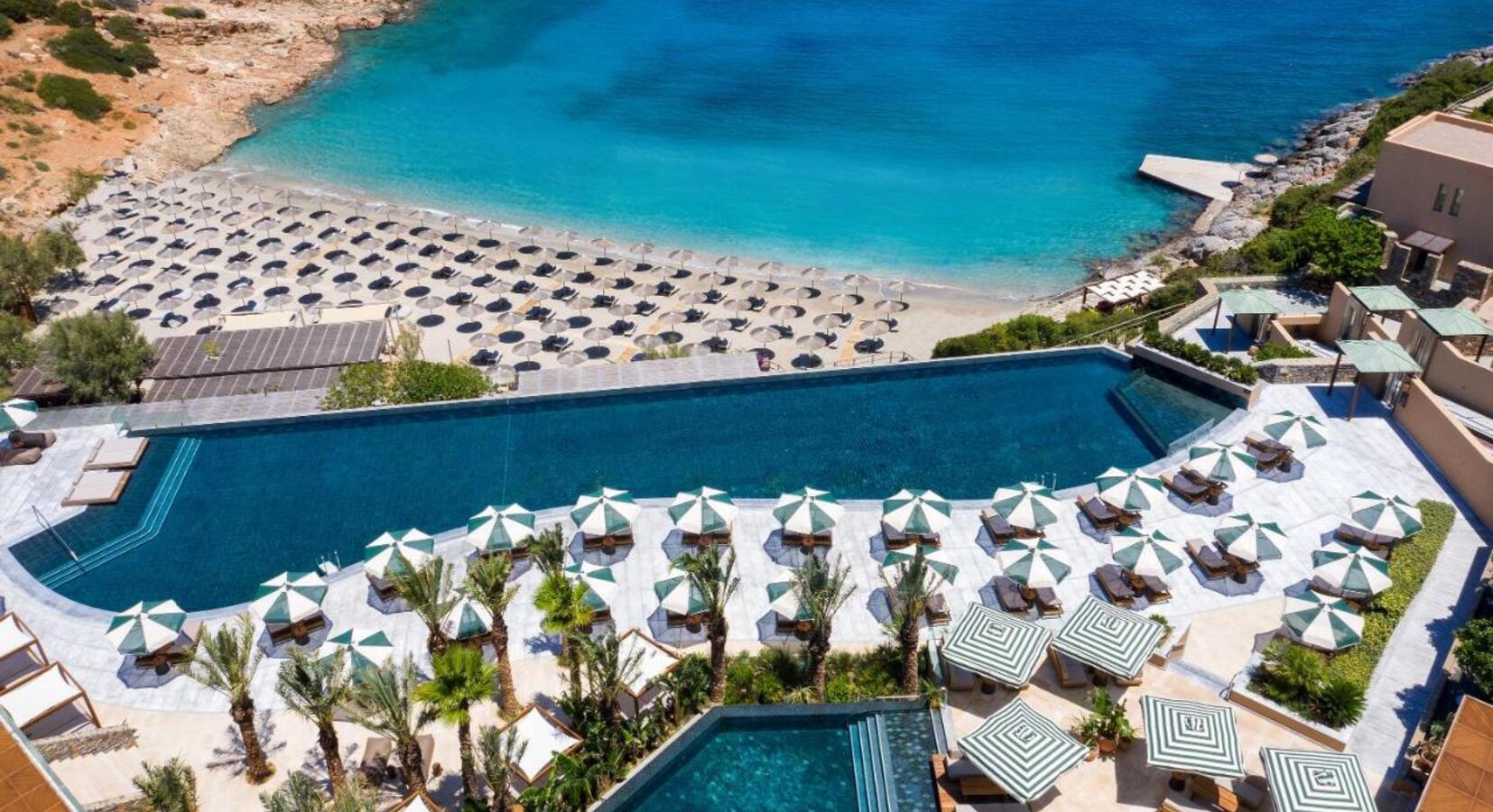
Daios Cove Luxury Resort
Crete is the only Greek island where you can be on a sandy beach by 11am and in a UNESCO-listed mountain village by 4pm, and that matters more than it sounds when you have a 14 month old who naps in the car. It is 3hr 55min direct from London Gatwick to Heraklion, 4hr 5min to Chania, and there is a 2 hour time difference which most under 2s absorb within 36 hours. The island is large enough to escape the package crowds and small enough that you do not need to plan a road trip. Crete also has the deepest bench of family hotels in Greece. Daios Cove on the east coast has a private sandy crescent reached by funicular from your room (a small mercy when you are carrying a sleeping toddler and three towels). Avra Imperial outside Chania runs Worldwide Kids childcare with the Alpha Creche taking babies from 4 months. Grecotel properties along the north coast all pack proper baby gear, sterilisers, cot rentals, plus shaded buggy paths between rooms and beach. Water is warm enough for paddling toddlers from late May, and the meltemi wind that flattens the Cyclades barely touches Crete's north coast in June. Eating out with a baby is straightforward: tavernas open at 7pm, expect children, will warm a bottle, will not flinch when half the rice ends up on the floor.
Stay here · Daios Cove Luxury Resort
Daios Cove wins on logistics. Your room is reached by a funicular that runs to the private sandy beach and pool deck, so a sleeping toddler in a sling does not need to be walked up a hill. The cove water shelves out gradually for about 15 metres. The Explorers Kids Club takes children from 4 years and the resort arranges in room babysitters for younger ones with notice. It is 45 minutes from Heraklion airport, which is short enough that an overtired baby will still make it without a full meltdown.
Read the full hotel reviewDon't miss · the beach reality
The honest version: most Cretan north-coast beaches are coarse sand mixed with small pebbles, not the powdery stuff you get on Mediterranean ad shoots. Avra Imperial's beach is pebbly at the waterline and uncomfortable for crawlers, though loungers are cushioned and shaded. Daios Cove's private cove is the closest to true sand on the east side, with water that shelves out gently for about 15 metres before it goes above an adult's waist. Grecotel resorts have engineered sand on Blue Flag stretches. Buggy access varies wildly: at hilly resorts like Daios you will use the funicular, at flat properties like Avra Imperial it is a 2 minute push from room to lounger. Bring proper water shoes for any pebble beach with a toddler. Public beaches near Rethymno are flat, sandy, and quiet midweek before 10am.
When to go
Late May to mid June is the window for under 2s: sea around 21 to 23C, daytime air 24 to 28C, hotels fully open, kids clubs running, half the August crowds. September through to the first week of October is the other clean window, with sea at its warmest (around 24C) and air dropping to 26 to 29C. July and August are doable but daytime temperatures regularly hit 33 to 36C and shade becomes a logistics problem with a baby. Avoid late October to April unless you are happy with cooler swims and patchy hotel opening. School-holiday tradeoff: end of May half term works, August is the price-and-heat spike.
Don't go if
Don't go if you want a short flight (it is the longest of the four destinations here). Don't go if pebble beaches are a dealbreaker and you cannot face water shoes. Don't go in August with a baby under one unless your hotel has properly shaded outdoor space and air conditioned indoor play. Don't go expecting walkable resort towns at the big package strips like Malia or Hersonissos.
Corfu
Greece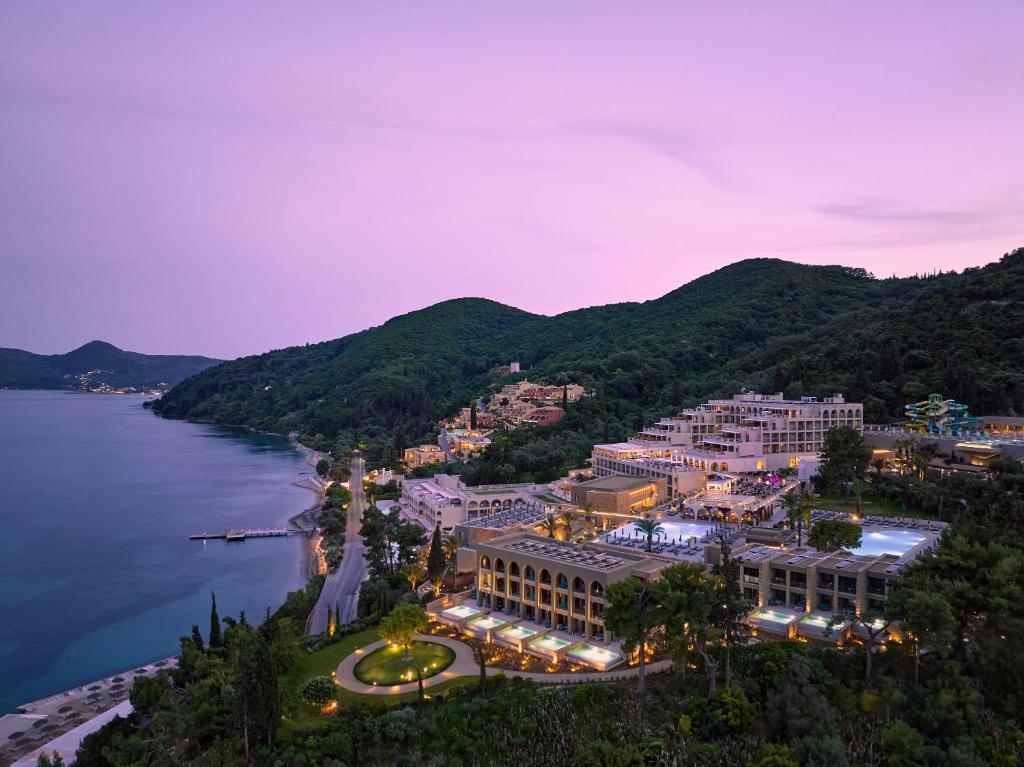
MarBella Corfu
Corfu is the Greek island that feels closest to Italy, and that does favours to families with very young children: the food is less reliant on grilled fish (more pasta, more bread, more things a fussy toddler will actually eat), the landscape is green rather than scorched, and the northeast coast has a string of small sandy coves rather than one big resort strip. Direct from London Gatwick it is 3hr 10min to Corfu airport, which is the shortest Greek-mainland flight in this set. MarBella Corfu on the east coast runs the Grasshoppers Creche from 4 months under the Worldwide Kids programme with qualified nursery staff and published staff ratios. Grecotel Corfu Imperial sits on its own private peninsula with calm shallow bays on three sides, which is unusually good geography for a baby who is just starting to walk. Ikos Dassia delivers the all inclusive option further north with a 4-month creche start. The island is small enough that you can do one cultural morning (Corfu Town's Venetian old town is UNESCO-listed and partly pedestrianised) without a long drive. Summer rainfall is genuinely rare, only around 11mm in July, and July highs sit around 31C with lows of 19C. The east coast hotels are sheltered from the prevailing wind, which matters when a 2-year old refuses a hat.
Stay here · MarBella Corfu
MarBella's Grasshoppers Creche takes babies from 4 months under the Worldwide Kids programme, with qualified nursery staff and published staff ratios. Sessions are 3 hours, 40 euros each, so two sessions a day costs 60 euros and gives parents a proper rest. The kids club for older siblings (4 to 12) is complimentary. The hotel sits on a sheltered east coast cove with shaded buggy paths from room to lounger. Open May to October. The east coast location means a 30 minute transfer from the airport, which is the right length with a baby.
Read the full hotel reviewDon't miss · the beach reality
Corfu's east coast is small coves rather than long beaches, and the composition varies hotel by hotel. MarBella's beach is a mix of small pebbles and imported sand, with a wooden walkway out to the loungers. The water there shelves quite quickly to swimming depth within 5 to 10 metres, which is fine for parents holding babies but not the long shallow shelf you get at Sani. Grecotel Corfu Imperial has multiple small bays including one engineered sand cove that is shallow for 15 metres. Most east coast hotel beaches require water shoes. The flatter sandy beaches are on the west coast (Glyfada, Agios Gordios) but those are public, busier, and a 30 minute drive from the family hotel cluster. Loungers come with proper shade at all the resorts named here.
When to go
Mid May to late June: air 22 to 28C, sea 20 to 23C climbing through June, kids clubs running, half the high summer crowds. September is the other strong window with sea at its warmest (around 25C) and air 25 to 29C, dropping noticeably in the last week. July and August work but daytime hits 31 to 33C and the popular east coast coves get busy by 10am. April and early May are too cool for proper sea swimming with a toddler. Avoid mid October onwards: Corfu gets the wettest winters in Greece, with November rainfall around 200mm.
Don't go if
Don't go if you want a 7km uninterrupted sand beach (that is Halkidiki). Don't go if you are picturing a quiet under the radar Greek island; Corfu has been a package destination since the 1970s. Don't go in October if rain would ruin the trip. Don't go to the south or far north coasts with a baby if you want a short transfer; Corfu airport traffic gets bad in July.
Puglia
Italy

Borgo Egnazia
Puglia is the Italian region where children eat the same food as the adults and no one raises an eyebrow at a buggy parked next to a tasting menu. I'd pick it when you want Italy that is not crowded, not Tuscan cliched, and not steep like the Amalfi Coast. London to Bari is two hours forty by direct flight from March to October; Brindisi is the same and forty four minutes closer to Savelletri, where most of the family grade hotels sit. Borgo Egnazia is the anchor property: a purpose built village styled like a fortified hamlet, with a nursery that accepts babies from seven months, a kids club from three, and a flat layout you can walk barefoot. Masseria San Domenico and Torre Maizza are the quieter, more grown up options nearby, both with private beach clubs and high chair without asking culture. The land is flat, which matters for buggies; the coast around Savelletri is a mix of small sand coves and rocky platforms with ladders into the water. The local food culture is genuinely accommodating to small children: orecchiette with simple tomato, focaccia, mozzarella, and grandmothers who will hold your baby while you finish your wine. Best months are May, June and September. July and August are hot (35C plus) and busier with Italian families.
Stay here · Borgo Egnazia
Borgo Egnazia is the only property in Puglia I know that combines a nursery taking babies from seven months, a kids club from age three, and a layout you can navigate with a buggy without fighting cobbles. It is forty four minutes from Brindisi airport, has its own private beach club with a shuttle to nearby sand, and the staff bring cots, bottle warmers and high chairs before you finish checking in. The food culture across its restaurants is unfussy about small diners.
Read the full hotel reviewDon't miss · the beach reality
Honest answer: Puglia's coast is more rock than sand. Borgo Egnazia's private beach club is built on a flat rocky platform with ladders and a small sandy cove next door; lovely but not the wade-in-from-the-sand experience Sardinia offers. The hotel runs a shuttle to a sand beach (Cala Masciola) about ten minutes away, with loungers reserved for guests. Masseria San Domenico and Torre Maizza have similar setups: sun deck on rock, shuttle to sand. The sand beaches that do exist (Pilone, Torre Canne, Savelletri town beach) are soft and shallow but get crowded by Italian families from mid July. If your toddler is at the stage of needing to dig and pat sand for an hour, factor in the shuttle.
When to go
Mid May to mid June is the calmest window: sea 21 to 23C, air 24 to 28C, almonds and olives in flower, hotels at maybe sixty percent capacity. Late June into early July is hotter (29 to 32C) but still workable with disciplined nap windows. August is the tradeoff month: 34 to 37C, sea at 26C, prices peak, Italian families everywhere, and many small town shops shut for Ferragosto week. September is excellent through about the 20th, with sea still at 24 to 25C and temperatures dropping to 26 to 29C. October closes the season; most masseria pools cool down and the family programming winds down by mid month.
Don't go if
Don't go if you need a sandy beach you can walk to from your room; you'll be on a shuttle. Don't go in August unless you book by January and accept the heat. Don't go if you want to see the Sassi of Matera or the Gargano in a single trip with a toddler; the drives are real. Don't go expecting Amalfi-style coastal drama; Puglia is flat, agricultural, and quieter, which is precisely the point.
How to choose between them
Three questions cut this list down to two or three real candidates.
1
How old is the youngest?
Under 7 weeks: Salzburg (Familotels from 7 to 30 days). 4 to 6 months: Halkidiki, Algarve, Mallorca, Costa del Sol, Crete, Corfu. From birth on a beach: Sardinia (Forte Village's Fisher Price nursery).
2
How long a flight can you face?
Around 3 hours from UK: Algarve, Costa del Sol, Mallorca, Malta, Salzburg, Puglia, Sardinia. 4 to 4.5 hours: Cyprus (Paphos is about 4h 35min from Gatwick), Halkidiki, Crete, Corfu. Nearly 5 hours: Morocco (Agadir). Anything longer, I would not pick for a first trip with a baby.
3
Beach or pool first?
Soft sand walk-from-room: Halkidiki, Sardinia, Mallorca, Algarve. Beach OK but pool dominant: Costa del Sol, Paphos, Corfu, Crete. Pool only (no beach): Salzburg, Puglia.
Frequently asked questions
Which European destination is best for travelling with a baby under one?
Halkidiki in Greece and the Algarve in Portugal are the two strongest picks for under ones. Sani Resort in Halkidiki has a Worldwide Kids creche from 4 months with published staff ratios and a 7km sand beach that shelves out 30m before adult waist depth. Martinhal Sagres in the Algarve is the only European hotel I know that splits under 2 childcare into a Nursery for 6 to 12 month olds and a separate Creche for 13 to 23 months. For newborns, Austrian Familotels like Moar Gut (from 30 days) and Dachsteinkönig (from 7 days) are unmatched anywhere else in Europe.
What is the shortest flight from the UK to a baby friendly European destination?
From London, the sweet spot is roughly three hours: Spain and Portugal (Malaga about 2h 45min, Faro about 2h 55min, Palma about 2h 25min). Malta is manageable at around three hours. Cyprus is four to four and a half, a stretch unless the hotel is worth it. Morocco can push nearly five hours. I have done it. Beautiful. Not what I would pick for trip number one. My rule: under five hours from the UK or Ireland, and aim for three when you can.
When is the best time to travel to Europe with a baby or toddler?
Late May to mid June and the back half of September are the two best windows across the Mediterranean: daytime 22 to 28C, sea 20 to 24C, hotels open with full kids club programmes, but without the school holiday crowds. July and August work logistically but daytime temperatures regularly hit 32 to 36C, which is brutal for naps and nappy rash. Austria is the only year round option in this guide: indoor thermal pools at 32C mean a baby can have their first swim in February as easily as July.
Are all inclusive resorts better than half board for families with babies?
For under 3s, almost always yes. The friction of leaving the hotel for meals with a baby (packing food, timing around naps, finding high chairs, navigating buggies through restaurant doors) is high. All inclusive at the premium end (Ikos, Sani, Forte Village, Club Med) eliminates all of that, includes baby food on the buffet, and lets you walk back to your room when a meltdown hits. Half board makes more sense once your eldest is 4+ and can sit through a proper restaurant meal.
How is this list different from other "best Europe with kids" guides?
Three ways. First, every destination here has been filtered for a single objective criterion: at least one verified hotel with a kids club accepting children from age 2 or younger. Most "kid friendly Europe" guides confuse "allows children" with "designed for children". Second, I list hotels by verified minimum age rather than amenity claims; the kids club minimum age is the single most important data point for parents of under 5s and most travel sites bury it. Third, I'm unflinching about downsides: Dalmatian beaches are pebble, French Riviera beaches are pebble, Provence is not on the coast. You will not find that honesty in a sponsored listicle.
Do you take commission from the hotels listed?
Some booking links may earn Tiny Trip Index a commission at no extra cost to you. Commercial relationships never determine which hotels I list, the order I put them in, their verification status, or the words I use to describe them.
Where next
If you have a shortlist, browse the index by your child's age, or read the methodology behind the verifications.